
.jpg?width=26&height=26&name=image%20(27).jpg)

That little plate under the bonnet can look like it was designed by someone who wanted motorhome...
.png?width=26&height=26&name=facebookmobile%20(Custom).png)
.png?width=26&height=26&name=instgrammobile%20(Custom).png)
.png?width=26&height=26&name=twittermobile%20(Custom).png)
.jpg?width=26&height=26&name=image%20(28).jpg)
Motorhome insurance is one of those things most of us buy with good intentions, then immediately file away somewhere sensible, which usually means a kitchen drawer full of takeaway menus, old MOTs and one mystery key nobody dares throw out. Then a claim happens, and suddenly the tiny details matter. Not just the headline price. Not just the excess. The tiny details.
The awkward truth is that many claim problems do not start with a dramatic crash or a clever thief in a balaclava. They start months earlier, when someone guessed their annual mileage, forgot to mention a solar panel, changed where the motorhome is stored, or assumed that a tracker subscription was still alive and well. Insurance is not meant to be a trap, but it is a contract, and contracts do tend to get very interested in the boring bits when money is on the table.
The big rule: answer what you are asked, then update what changes
For personal insurance, the legal starting point is fairly straightforward. Under the Consumer Insurance Disclosure and Representations Act 2012, you must take reasonable care not to misrepresent your circumstances when buying or renewing insurance.1 In plain English, if the insurer asks a clear question, do not guess, blag, soften it, or answer what you wish was true. Answer what is actually true.
That does not mean insurers can do whatever they like if a mistake appears later. The Financial Ombudsman Service says it will look at whether the insurer asked clear and specific questions, whether the information was incorrect or incomplete, whether the insurer would have acted differently, and whether the customer took reasonable care.2 So no, forgetting one minor thing does not automatically mean your claim is doomed. But if the missing information was important, and especially if you were asked about it directly, the insurer may reduce the claim, apply restrictions, charge extra premium, or in serious cases avoid the policy altogether.2
Declared storage is not just small talk
When you tell an insurer where the motorhome is usually kept overnight, they are not being nosy for sport. Storage affects the theft risk, the vandalism risk and sometimes the weather risk too. A motorhome parked on a locked drive behind gates is not the same risk as one left on the road outside a busy pub car park where wing mirrors go to die.
Specialist motorhome insurers commonly price policies using details such as storage location, security and annual mileage.3 Caravan Guard, for example, advertises discounts linked to secure home storage, electronic security systems and low mileage.4 That tells you something important: if storage earns a discount, storage is part of the deal. If you later move the motorhome from a secure compound to the street, or from your home to a friend’s farm, tell the insurer. The answer may be “that is fine”. It may be “there is a small premium change”. Either answer is better than trying to explain it after a theft.
Modifications: declare the glamorous ones and the boring ones
Motorhome people love a tweak. A reversing camera here, a lithium battery there, a solar panel on the roof, a bike rack, an awning, uprated suspension, satellite kit, extra locks, different wheels, a remap, maybe a layout change if someone has been left alone with YouTube and confidence. Some changes are sensible. Some are brilliant. Some look like a crime scene in a leisure vehicle showroom. Insurance wise, the key question is not whether the modification is tasteful. It is whether it changes the vehicle from the manufacturer’s standard specification.
The Financial Ombudsman Service defines a vehicle modification as a change that is not part of the manufacturer’s standard specification, and it warns that undeclared significant changes can affect whether a policy remains valid.5 It has seen cases where claims were refused because modifications were not declared, but also cases where the insurer was told to reinstate cover because an average customer could not reasonably have known something was a modification.5 That is an important distinction, but it is not one you want to test during a claim. If in doubt, ask before you fit it, and keep the answer in writing.
Not all modifications are treated the same
A sticker of the dog’s name on the back door is unlikely to trouble anyone, unless the dog has its own solicitor. But performance changes, wheel changes, electrical work, gas work, structural alterations, seat changes, extra belted seats, non standard windows, suspension changes and expensive accessories can all matter. The insurer may accept them, charge extra, exclude the value of the upgrade, ask for proof of professional fitting, or decline cover.
One very common mistake is assuming that declaring a modification means the modification itself is fully insured for its replacement cost. It may not be. The Ombudsman has specifically noted complaints where owners told their insurer about modifications and paid more, only to discover during a claim that the value of the modification was not covered in the way they expected.5 So ask two separate questions: “Will you cover the motorhome with this fitted?” and “Will you pay for this item if it is damaged or stolen?” Those are cousins, not twins.
Mileage limits are not decorative
Many motorhome policies ask for annual mileage because motorhomes are often used very differently from everyday cars. One owner might do 1,500 miles a year, mostly to the coast and back. Another might disappear around Europe for months and return with 11,000 miles, a sun tan and a suspicious fondness for French supermarket diesel. Those are not the same insurance risk.
Low mileage can reduce premiums on some specialist policies.4 That is lovely when you are genuinely a low mileage owner, but less lovely if you picked a low number to save money and then quietly sailed past it by August. If your policy has a mileage cap, keep an eye on it. If your plans change, call before you exceed it. Do not wait until the assessor sees the odometer and starts doing sums with the expression of a maths teacher who has found a forged homework note.
Security devices only help if they actually exist and work
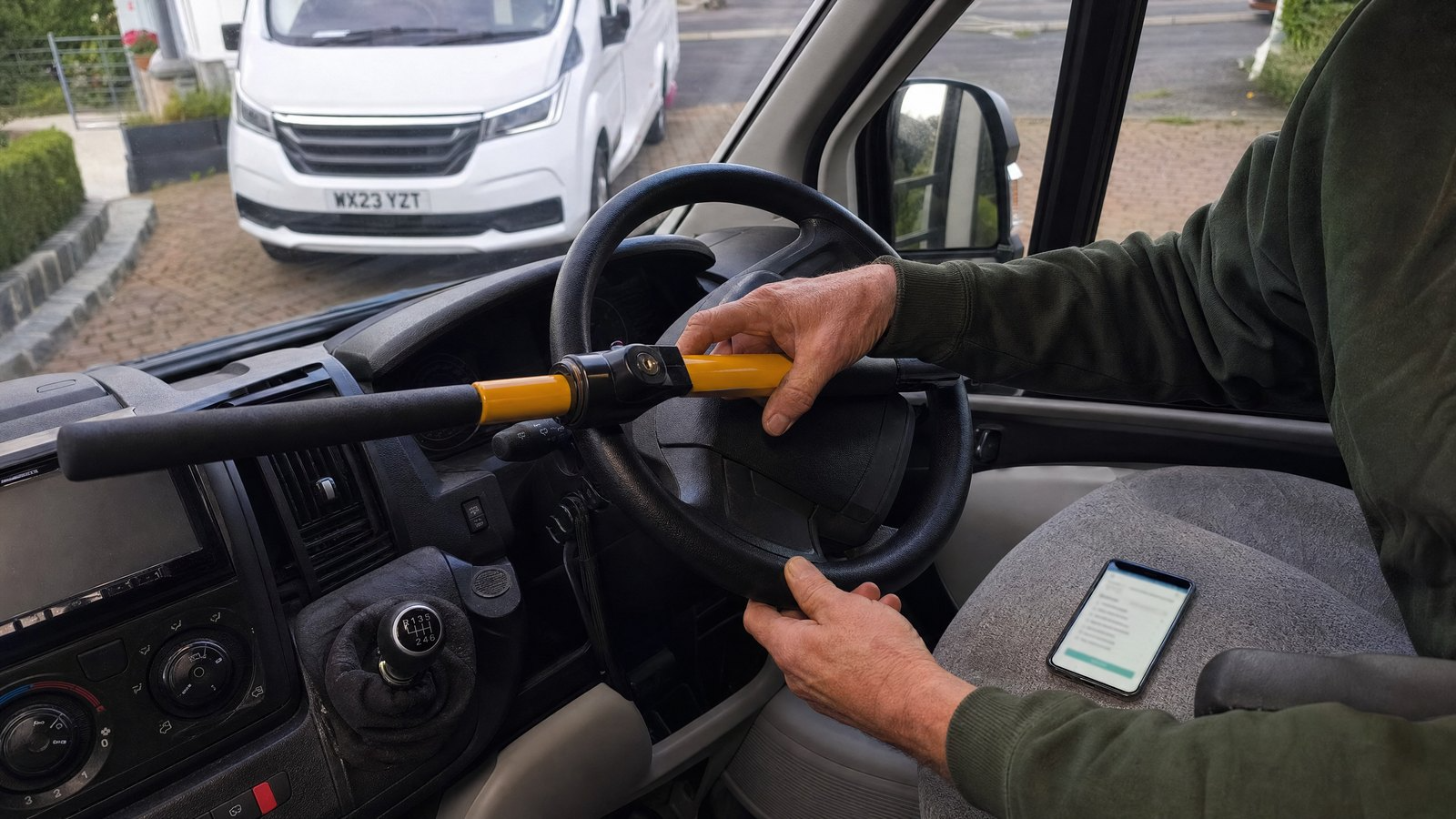
Security is one of the odd areas where owners can accidentally create a problem by being too optimistic. If you tell the insurer the motorhome has an approved alarm, immobiliser, wheel lock or tracker, then that is what the insurer is relying on. If the tracker subscription has expired, the alarm was disconnected because it kept upsetting the neighbours, or the steering lock lives permanently in the garage because it is “a bit fiddly”, you may have a problem.
Comfort Insurance makes this point very directly, warning that declared security should be operational and that maintaining an active tracker subscription is crucial because a lapse could cause claim complications.3 Some policies also exclude theft where the motorhome has not been properly secured, or where the keys are left in or on the vehicle.3 That may sound obvious, but claims rarely happen in perfect conditions. People leave keys in coat pockets. Spare keys sit in drawers. Trackers get renewed on an email account nobody checks. Boring admin, unfortunately, is part of security.
Driver restrictions: check licences, ages and named drivers
Motorhomes bring a slightly different driver problem because size and weight matter. Some owners can drive certain heavier motorhomes because of older licence entitlements, while others may need specific categories depending on the vehicle’s maximum authorised mass. If the wrong person drives, it is not just a legal issue. It can also become an insurance issue.
Motorhome policies may exclude accidents caused by someone driving without the appropriate licence, and some policies exclude drivers who are not permitted by the policy terms.3 Lifesure also notes excluded drivers can include those without a driving licence or disqualified drivers.6 This is worth checking before you hand the keys to a relative who says, “I’ve driven vans before.” A motorhome is not a van with cushions. It is a house with a dashboard and a turning circle that can embarrass you in public.
European cover: minimum cover is not the same as good cover
Driving abroad is where assumptions breed like rabbits. UK motor insurance can provide the minimum compulsory cover required in many European countries, but minimum cover is not the same as the comprehensive cover you enjoy at home. Your policy schedule matters. If you want comprehensive cover abroad, check it is included, check the countries, check the number of days, and check whether breakdown cover is separate.
Caravan Guard explains that its European motorhome insurance option is shown on the policy schedule and may allow travel for up to 9 months in a policy year, with a maximum of 180 consecutive days in any one country.4 It also lists countries where additional cover may be required and notes that Green Cards may be needed for certain destinations.4Your own insurer may have different rules, which is exactly the point. Do not rely on pub wisdom, forum folklore, or the phrase “I’m sure we’re covered”. Ask, read, save the confirmation, then go and enjoy the cheese.
Agreed value: useful, but not magic
Agreed value cover can be very useful for older, classic, rare, restored or heavily upgraded motorhomes where ordinary market value might not reflect what the vehicle is genuinely worth. Instead of waiting until a total loss and then arguing over adverts for vaguely similar vehicles, the insurer and owner agree a value in advance. That can make a horrible situation slightly less horrible, which is about as much comfort as insurance ever promises.
But agreed value is not a magic spell you cast once and forget. Just Kampers Insurance explains that agreed value often requires photographs, receipts for parts and labour, and sometimes an independent expert valuation.7 It also notes that agreed value can be valid for a year and may need updating at renewal.7 If you restore the interior, fit expensive equipment, or values move sharply, refresh the evidence. A folder of dated photos, invoices, service history and valuation documents can be worth its weight in very expensive motorhome parts.
The paperwork that helps a claim go smoothly
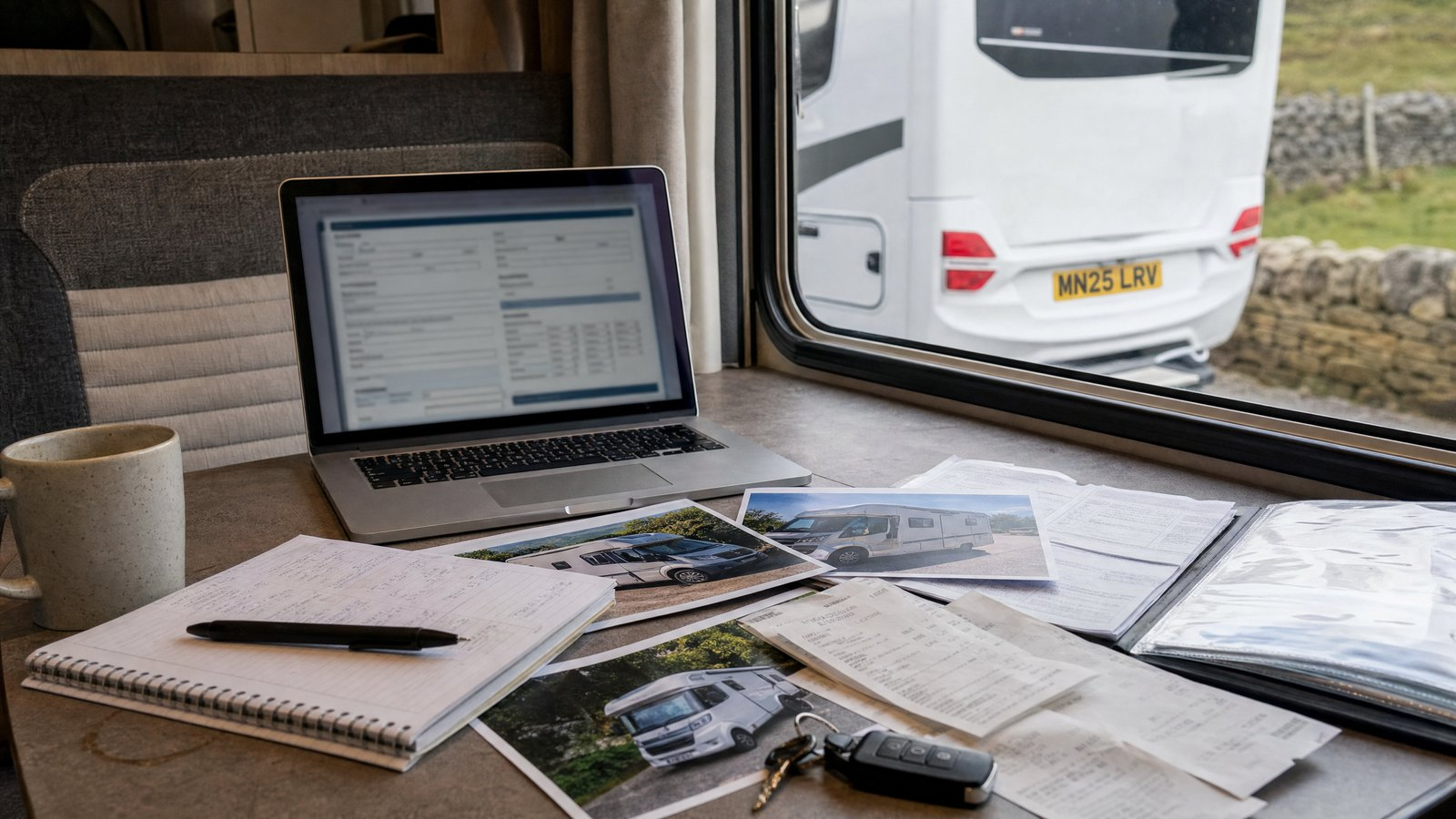
The best time to build your claim file is when nothing has happened. That sounds deeply unexciting, but future you may be grateful. Keep your V5C details, MOTs, service records, habitation checks, modification invoices, security certificates, tracker subscription proof, photographs and valuation evidence somewhere easy to find. Cloud storage is useful, provided you can remember the password and it is not “Motorhome123”, because we are trying to reduce risk here, not audition for a cyber security training video.
Take clear photos of the motorhome at least once a year: all sides, interior, roof accessories, mileage, VIN plate if accessible, security devices and any notable extras. If you add anything, photograph it and keep the receipt. If you ask the insurer a question, keep the reply. If you speak on the phone, note the date, time and what was agreed. This is not paranoia. It is simply making sure that if a claim happens, you are not relying on memory while stressed, annoyed and possibly standing in the rain next to a damaged vehicle.
Renewal is where many mistakes sneak in
Renewal emails are easy to skim. They arrive when you are busy, and half the wording seems designed to send a normal person into a light coma. But renewal is one of the most important moments in the policy year because the insurer is asking you to confirm the details are still correct. The ABI says customers have a duty to check renewal notices and tell the insurer if information has changed or is wrong.1
So before you renew, ask yourself a few dull but useful questions. Is the motorhome still stored where the policy says it is stored? Is the mileage still realistic? Have you fitted anything? Has anyone else started driving it? Has the value changed? Are you planning a long European trip? Have you changed your job, address or use of the vehicle? Ten minutes of checking can save weeks of arguing.
If a claim is challenged, do not panic, but do get organised
If an insurer raises a concern about disclosure, storage, mileage or modifications, ask for the reason in writing and ask which policy term they are relying on. Then gather evidence calmly. The Financial Ombudsman Service expects insurers to consider whether questions were clear, whether the answer was wrong or incomplete, whether it made a difference, and whether the customer took reasonable care.2 That means context matters.
If you think the insurer is being unfair, complain to the insurer first. If you are still unhappy after its final response, or if it does not reply within the required timescale, you may be able to take the complaint to the Financial Ombudsman Service.2 Hopefully it never gets that far. Most of the time, the sensible approach is much simpler: be accurate, update changes quickly, keep evidence, and never assume the policy says what you would like it to say.
The practical takeaway
Motorhome insurance is not just about finding the cheapest quote and hoping for the best. It is about making sure the policy matches the motorhome you actually own, the way you actually use it, where you actually keep it, and who actually drives it. Glamorous? Not remotely. Useful? Absolutely.
Before your next renewal, put the kettle on and give your policy a proper read. Check the storage, mileage, drivers, European cover, security devices, modifications and value. If something has changed, tell the insurer. If something is unclear, ask. It may feel like admin now, but if you ever need to claim, those little details can be the difference between a smooth payout and a very expensive lesson.
Subscribe to our newsletter and get the latest articles delivered straight to your inbox.

That little plate under the bonnet can look like it was designed by someone who wanted motorhome...
Right then, let’s be honest. A motorhome is not a vehicle. It is a travelling orchestra of panic,...
If your dog has already started wagging at the sight of the motorhome keys, I have good news and...

