
.jpg?width=26&height=26&name=image%20(27).jpg)

Your motorhome's speed limit depends on its unladen weight, the road and whether you are towing....
.png?width=26&height=26&name=facebookmobile%20(Custom).png)
.png?width=26&height=26&name=instgrammobile%20(Custom).png)
.png?width=26&height=26&name=twittermobile%20(Custom).png)
.jpg?width=26&height=26&name=image%20(28).jpg)
That little plate under the bonnet can look like it was designed by someone who wanted motorhome owners to suffer. It is usually dirty, half hidden and covered in numbers that seem simple until you actually try to work out what they mean.
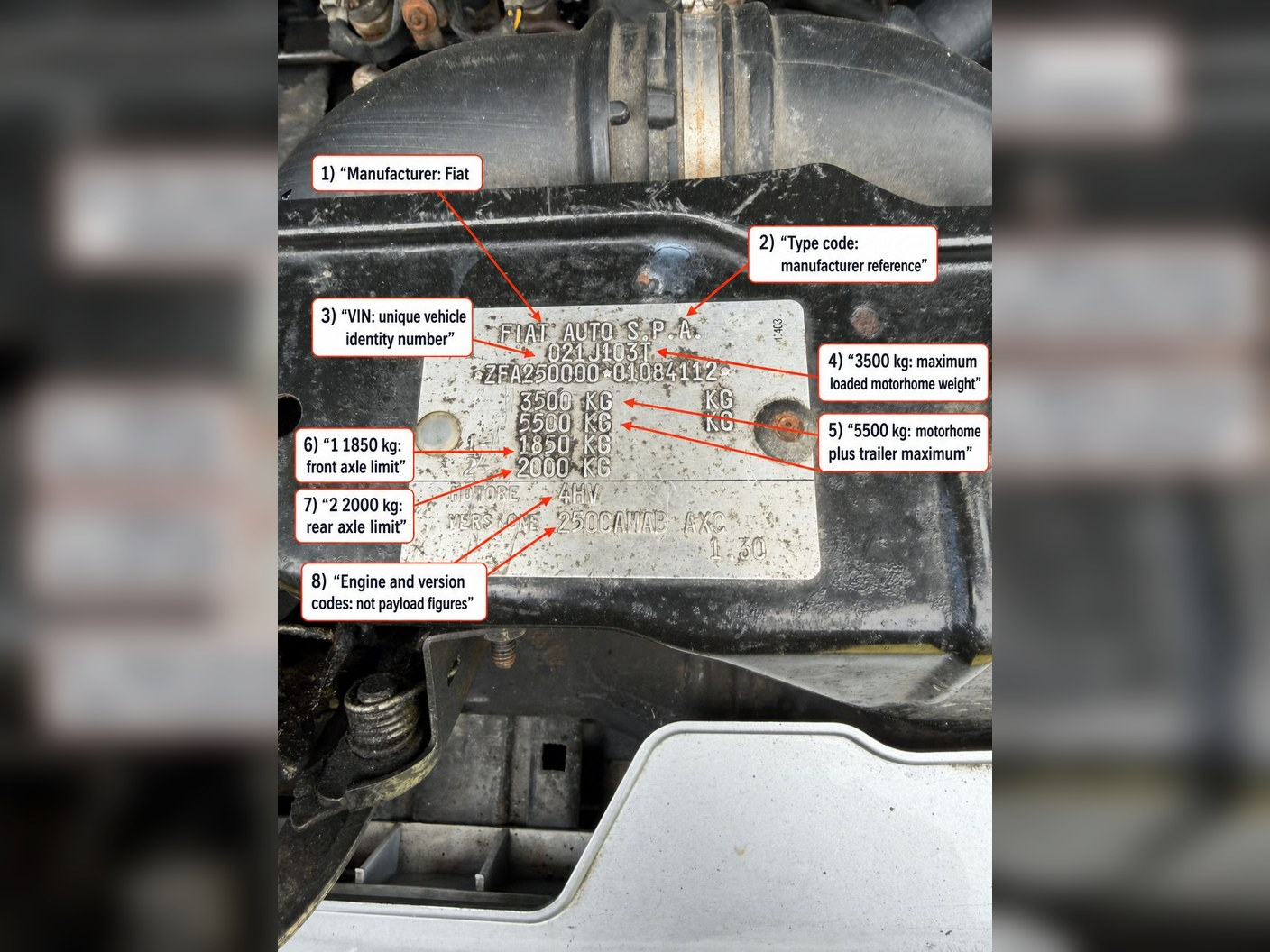
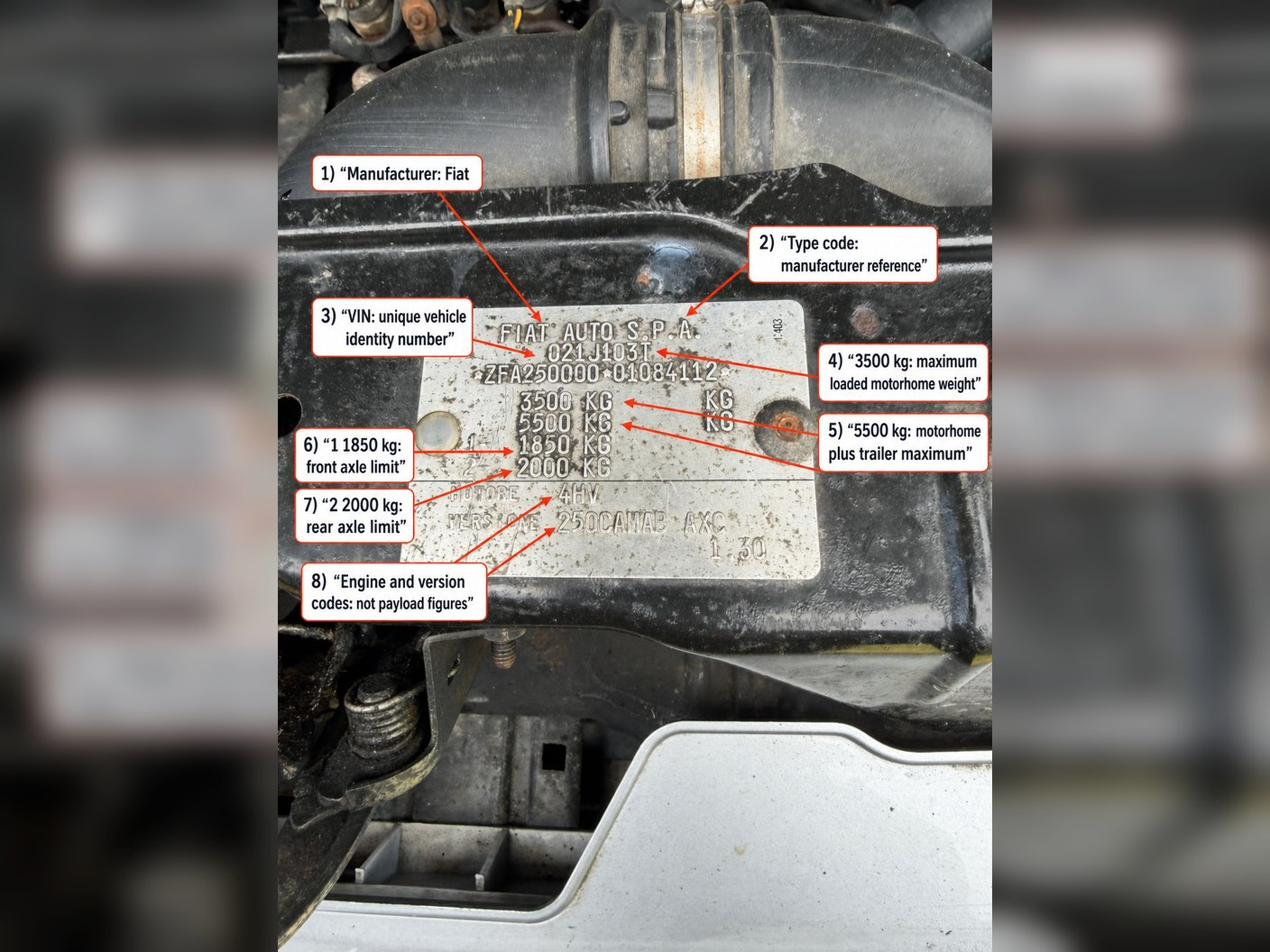
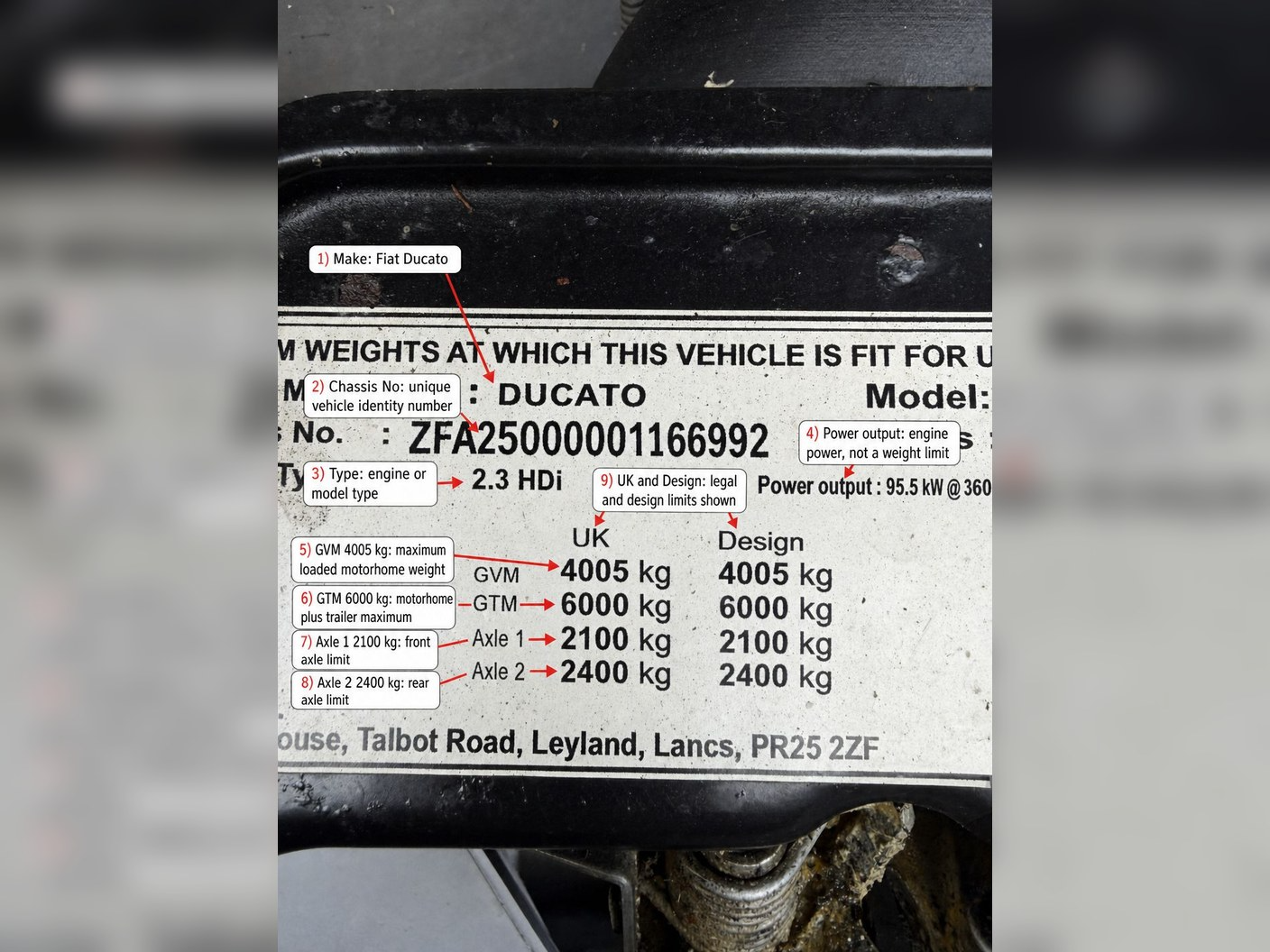
The good news is that the plate is not trying to be clever. It is mainly telling you the vehicle identity, the maximum weight of the motorhome, the maximum weight if towing, and the maximum weight allowed on each axle.
The four numbers that really matter
The first big weight is the one most owners need to know. If it says 3500 kg, the motorhome must not weigh more than 3500 kg when it is fully loaded. That means passengers, fuel, water, gas bottles, food, clothes, bikes, tools, dogs and all the “just in case” items that somehow end up in the lockers. GOV.UK calls this the maximum authorised mass, or MAM.1
The second big weight is the towing figure. This is often called the gross train weight. It means the maximum allowed weight of the motorhome and trailer together.1 If the plate says 6000 kg, the motorhome and trailer together must not go over 6000 kg.
The axle numbers are just as important
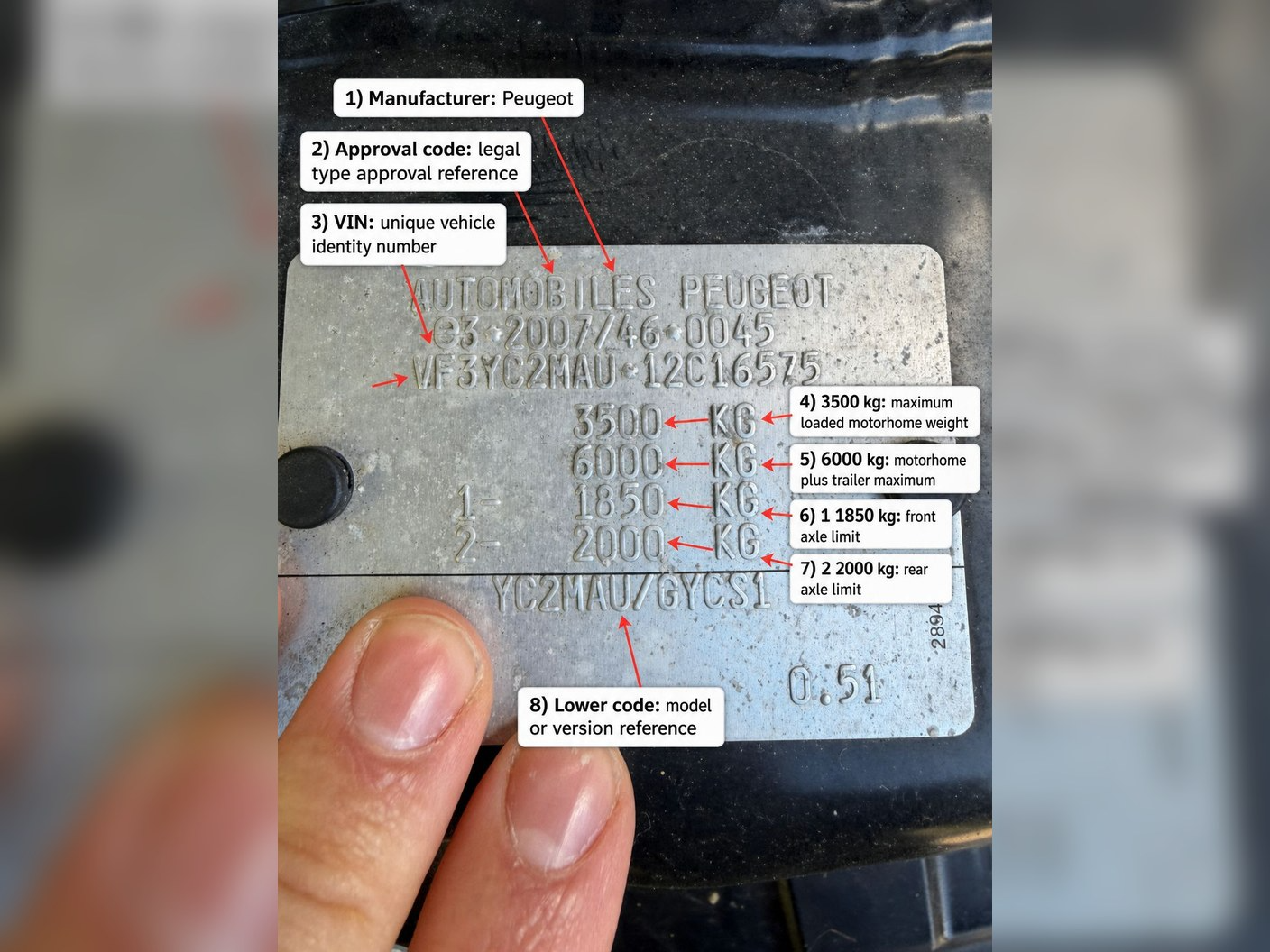
The line marked 1 is the front axle limit. The line marked 2 is the rear axle limit. If the front axle line says 1850 kg, the front axle must not carry more than 1850 kg. If the rear axle line says 2000 kg, the rear axle must not carry more than 2000 kg.
This is where motorhome owners can get caught out. It is possible to be under the total weight limit but still be overloaded on the rear axle. Rear garages, bike racks, extra batteries, scooters, full water tanks and spare gas bottles all tend to add weight behind the back wheels. DVSA advises weighing a loaded vehicle and checking individual axle weights where possible.2
Why the axle weights can add up to more than the total
This bit looks odd at first. A plate might show 3500 kg as the maximum loaded weight, but the axle limits might be 1850 kg at the front and 2000 kg at the rear. Added together, that is 3850 kg. Sadly, that does not mean there is a secret extra 350 kg available.
It just gives the vehicle some flexibility in where the weight sits. The whole motorhome must still stay under its maximum weight. At the same time, each axle must stay under its own limit. All of those checks matter.
What each line usually means
The wording changes between manufacturers, but most plates follow the same basic idea. Fiat, Peugeot, Citroen and other base vehicles may lay the information out slightly differently, yet the important weight lines are usually in the same order.
|
Line on the plate |
What it means |
Plain English meaning |
|
Manufacturer name |
Base vehicle maker |
The company that built the base vehicle |
|
Long number beginning VF, ZFA or similar |
VIN or chassis number |
The vehicle identity number, which should match the V5C |
|
Engine or type code |
Model or engine information |
Useful identification detail, not a weight limit |
|
Power output |
Engine power |
This is about engine output, not payload |
|
First main weight |
Maximum loaded weight |
The most the motorhome can weigh when fully loaded |
|
Second main weight |
Gross train weight |
The most the motorhome and trailer can weigh together |
|
Axle 1 |
Front axle limit |
The most weight allowed on the front axle |
|
Axle 2 |
Rear axle limit |
The most weight allowed on the rear axle |
|
UK and Design columns |
Legal and design limits |
Approved limits, often showing the same figures |
A simple 3500 kg example
If a plate shows 3500 kg as the first main weight, that is the maximum loaded weight of the motorhome. Everything inside and on the motorhome counts towards that figure. People count, water counts, fuel counts, bikes count and the emergency tin of biscuits absolutely counts.
If the next line shows 5500 kg or 6000 kg, that is the motorhome and trailer limit together. It does not mean the motorhome alone can weigh that much. It only applies when towing, and the motorhome still has to stay within its own separate limit.
A higher weight example
Some motorhomes have a higher plated weight, such as 4005 kg. That can give more carrying capacity than a 3500 kg motorhome, but it also brings another important question: can the driver legally drive it?
In the UK, many drivers need the correct licence category to drive a motorhome over 3500 kg, so the number on the plate and the licence both matter.3 A bigger number on the plate is useful only if the driver is allowed to use it.
The plate does not tell you your payload
This is the big misunderstanding. The plate gives the limits, but it does not tell you how much spare weight is actually available. Payload is the difference between what the motorhome is allowed to weigh and what it really weighs.
For example, if a motorhome is allowed to weigh 3500 kg and it actually weighs 3200 kg with fuel, driver and basic kit, there is 300 kg left. Add a passenger, food, water, bikes and a few “just in case” items, and that 300 kg can disappear very quickly.
The easiest way to know for sure
The best answer is a weighbridge. Load the motorhome as if it is going away, then weigh it. Ideally, get the total weight and separate axle weights. That way it is clear whether the whole motorhome is legal and whether each axle is legal too.2
Overloading is not just a technical issue. DVSA says an overloaded vehicle can be less stable, harder to steer and slower to stop. It can also put extra strain on tyres.2 In other words, the plate is not there to spoil the holiday. It is there to stop the holiday becoming a recovery truck story.
The quick way to remember it
First big number: the motorhome’s maximum loaded weight. Second big number: motorhome plus trailer maximum. Number 1: front axle. Number 2: rear axle. The long VIN or chassis number identifies the vehicle.
If there is one thing to remember, make it this: the plate tells you the limits, but the weighbridge tells you the truth.
Subscribe to our newsletter and get the latest articles delivered straight to your inbox.

Your motorhome's speed limit depends on its unladen weight, the road and whether you are towing....
If you’re new to the world of motorhomes, the subject of weights can feel a little confusing at...

The Electric Dream Hits the Road

