
.jpg?width=26&height=26&name=image%20(27).jpg)

Welcome back, fellow road-trippers! Siobhan here with the penultimate instalment of our epic...
.png?width=26&height=26&name=facebookmobile%20(Custom).png)
.png?width=26&height=26&name=instgrammobile%20(Custom).png)
.png?width=26&height=26&name=twittermobile%20(Custom).png)
.jpg?width=26&height=26&name=image%20(28).jpg)
Welcome back, fellow road-trippers! Siobhan here, and I can hardly believe it, but we have finally reached the end of the road. After navigating the mountain passes of Switzerland, the strict toll systems of Poland, and the narrow lanes of Ireland, we are wrapping up our epic 20-country European motorhome guide. We've saved two very different, but equally brilliant, destinations for our grand finale.
In this final instalment, we are exploring the thermal baths and major 2026 toll changes in Hungary, before heading over to the tiny, toll-free transit haven of Luxembourg. Whether you're planning a deep dive into Eastern Europe or just need a handy stopover on your way to France, these two countries are essential additions to your itinerary. So, put the kettle on one last time, grab a biscuit, and let's get you prepped for the final leg of our European tour.
Hungary: Thermal baths and major toll changes
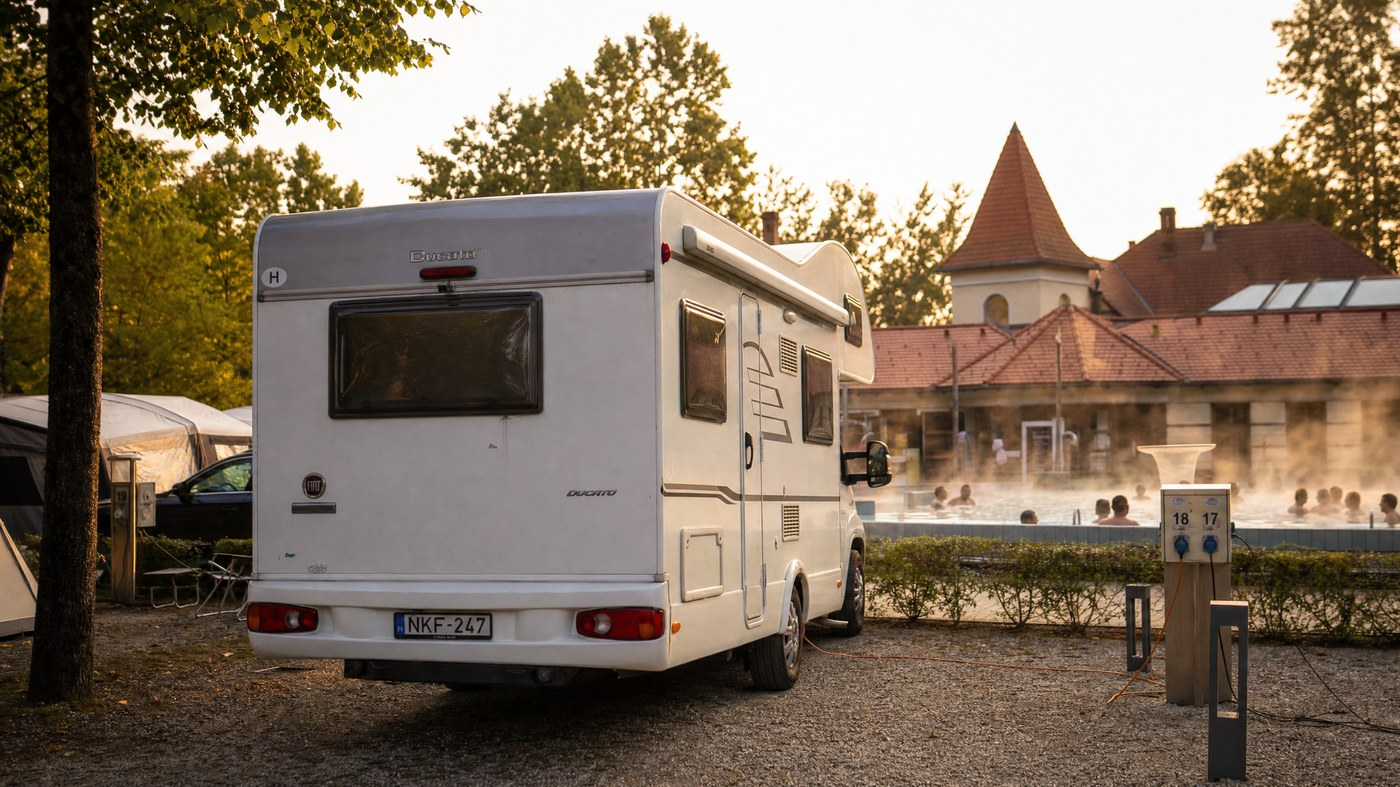
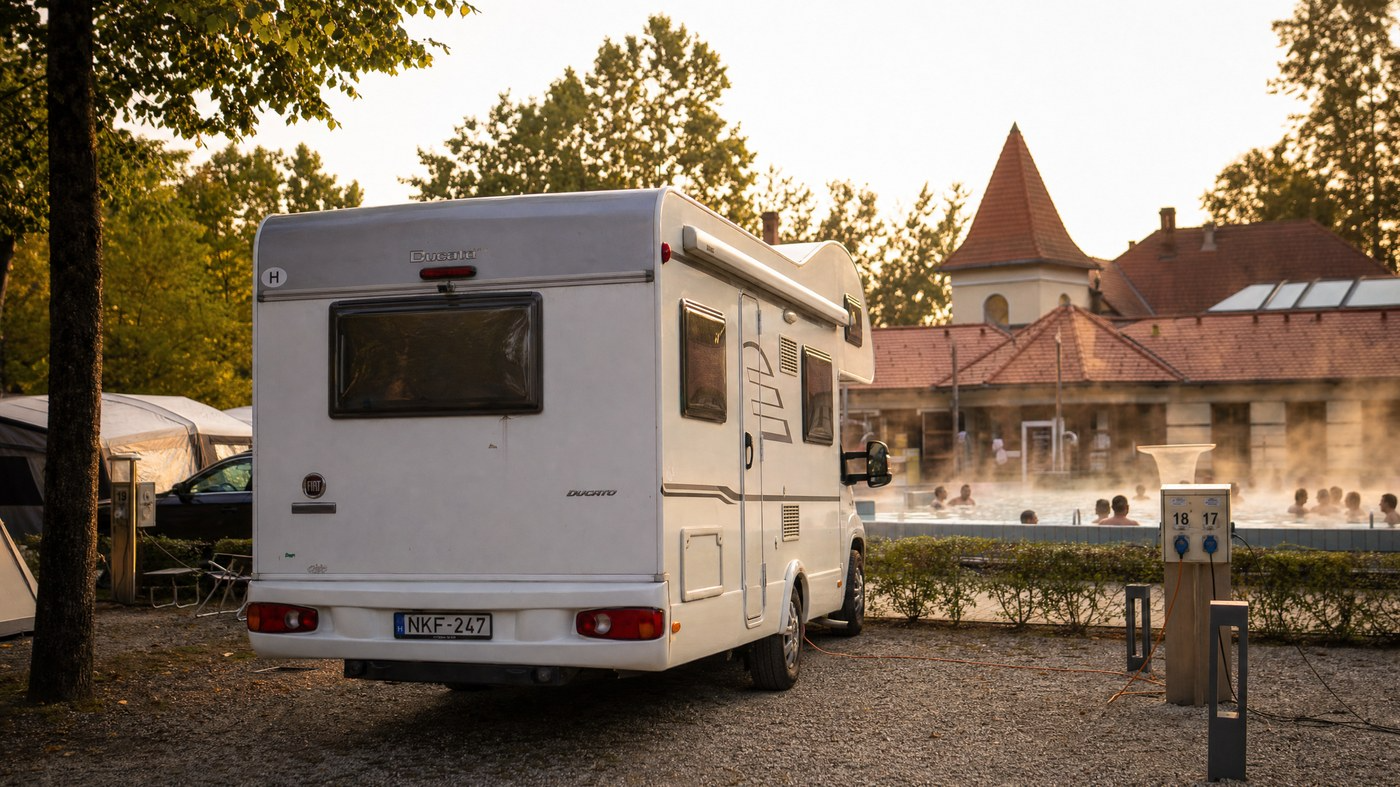
Hungary is a fantastic destination for a motorhome adventure. Beyond the stunning architecture and vibrant culture of Budapest, the country offers vast plains, the massive Lake Balaton, and a unique culture of thermal bath campsites. Imagine pulling up in your motorhome, hooking up the electrics, and wandering straight into a naturally heated thermal pool. It's an absolute dream. The road network is generally excellent, especially the motorways, though some secondary rural roads can be a bit rough around the edges.
However, if you are planning a trip to Hungary, you need to be aware of a massive change to their toll system that came into effect on 1st January 2026. Previously, heavy motorhomes over 3.5 tonnes were lumped in with HGVs and had to use the complex, distance-based HU-GO system with an on-board tracking unit. Thankfully, that is no longer the case. From 2026, ALL recreational vehicles, regardless of weight, now use the much simpler e-vignette system.
Hungarian vignettes and zero-tolerance laws
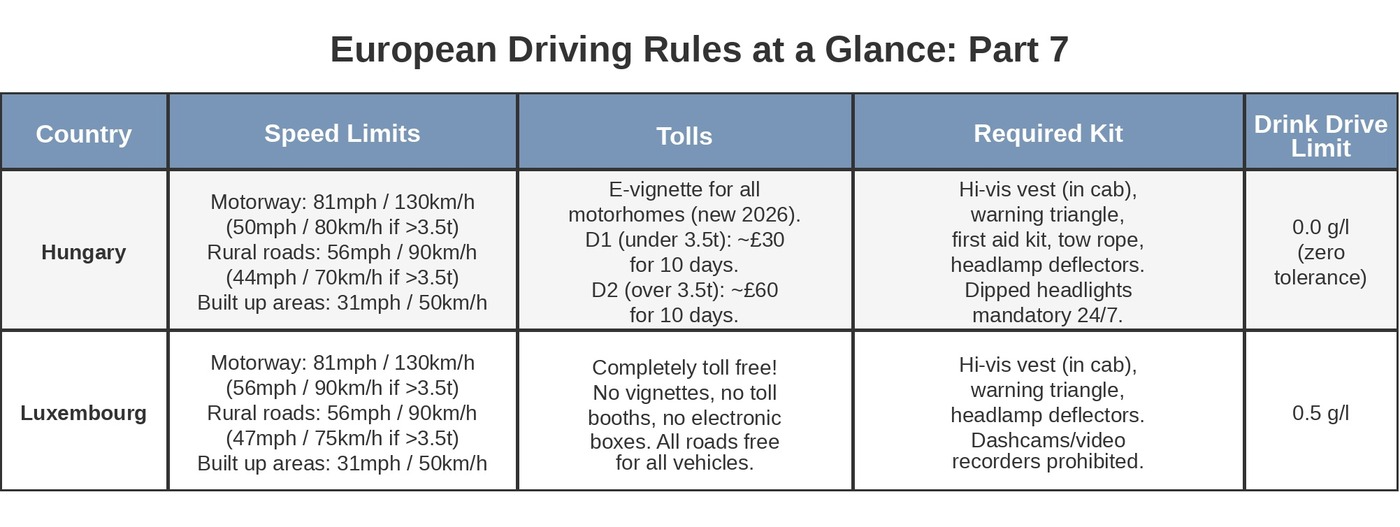
The new e-vignette system is entirely electronic and linked to your registration plate, meaning there are no physical stickers to scrape off your windscreen. Motorhomes up to 3.5 tonnes (and with a maximum of 7 seats) fall into the D1 category, which costs around 15,000 HUF (£30) for a 10-day pass. If your motorhome is over 3.5 tonnes, you now fall into the D2 category, costing roughly 30,000 HUF (£60) for 10 days. You can buy these online at ematrica.hu before you travel. Do not risk driving without one; the camera network is extensive, and the fines are hefty.
When it comes to driving rules, Hungary is famously strict. They operate an absolute zero-tolerance policy on drink-driving. The limit is 0.00%, meaning you cannot have even a sip of alcohol before getting behind the wheel. Speed limits are standard: 50km/h (31mph) in built-up areas, 90km/h (56mph) on rural roads, and 130km/h (81mph) on motorways. However, if your motorhome is over 3.5 tonnes, you are restricted to 70km/h on rural roads and 80km/h on motorways. Wild camping is strictly prohibited, so stick to the official campsites or designated motorhome parking areas.
Luxembourg: The tiny, toll-free transit hub
Now we jump across the continent to Luxembourg. This tiny Grand Duchy is sandwiched between Belgium, France, and Germany, covering an area of just 2,586 square kilometres. You can literally drive across the entire country in about half an hour. Because of its location, it is incredibly popular as a transit country for UK motorhomers heading south. But don't just rush through; the Ardennes region in the north is beautiful, packed with dense forests, winding valleys, and some surprisingly excellent campsites.
The best thing about driving in Luxembourg? It is completely toll-free. There are no vignettes to buy, no toll booths to queue at, and no electronic boxes to stick to your dashboard. All roads, including the immaculate motorways, are entirely free for all vehicles. On top of that, fuel is notably cheaper in Luxembourg than in any of its neighbouring countries. It is practically a tradition for motorhomers to cross the border with an empty tank just to fill up on cheap diesel.
Luxembourg driving rules and the dashcam ban
Speed limits in Luxembourg are straightforward. In built-up areas, the limit is 50km/h (31mph). On rural roads, it's 90km/h (56mph), and on motorways, it's 130km/h (81mph). If you are driving a heavy motorhome over 3.5 tonnes, your rural limit drops to 75km/h, and your motorway limit is restricted to 90km/h. The drink-drive limit is a standard 0.05%, but this drops to a strict 0.02% if you have held your licence for less than two years.
When it comes to equipment, Luxembourg has one crucial rule that catches many UK drivers out: dashcams and video recorders are strictly prohibited from being used in vehicles. If you have one fitted to your motorhome, you must ensure it is completely disabled or removed while driving in the country. You must carry a warning triangle, and a high-visibility vest is mandatory for the driver and all passengers if you have to step out of the vehicle on a motorway or rural road. Like Hungary, wild camping is completely banned, so you must use official sites.
The end of the road
And there we have it! Twenty countries, countless speed limits, a dizzying array of vignettes, and more required warning triangles than you can shake a stick at. Planning a European motorhome trip can seem daunting, but as long as you do your research, carry the right kit, and keep an eye on those toll systems, it is the most rewarding way to travel.
I hope this series has given you the confidence to pack up your motorhome, book that ferry, and hit the open road. Whether you're heading for the sunny beaches of Spain, the dramatic fjords of Norway, or the thermal baths of Hungary, Europe is waiting for you. Safe travels, everyone, and I'll see you on the campsite!
Subscribe to our newsletter and get the latest articles delivered straight to your inbox.

Welcome back, fellow road-trippers! Siobhan here with the penultimate instalment of our epic...
Welcome back, fellow road-trippers! Siobhan here with the fourth instalment of our mammoth...
Welcome back, fellow road-trippers! Siobhan here with the fifth instalment of our mammoth...