.jpg?width=26&height=26&name=image%20(27).jpg)

The Electric Dream Hits the Road
.png?width=26&height=26&name=facebookmobile%20(Custom).png)
.png?width=26&height=26&name=instgrammobile%20(Custom).png)
.png?width=26&height=26&name=twittermobile%20(Custom).png)
.jpg?width=26&height=26&name=image%20(28).jpg)
Hello again, my intrepid road-trippers! Siobhan here, back with the third instalment of our epic 20-country European motorhome adventure. If you’ve been with us from the start, you’re now a certified expert on driving in France, Italy, Belgium, Spain, Germany, and Switzerland. If you’re just joining us, welcome! I recommend having a quick look at Part 1 and Part 2 to get up to speed on the essentials like cross-channel travel and the necessary paperwork.
This time, we’re diving into a wonderfully eclectic mix of countries, each offering a completely unique experience. We’ll be soaking up the sun-drenched Atlantic coast of Portugal, navigating the pancake-flat, cycle-friendly landscapes of the Netherlands, and tackling the majestic, rule-heavy alpine roads of Austria. It’s a journey of contrasts, but that’s what makes motorhoming so addictive, right? So, grab a biscuit (or a pastel de nata in preparation), and let’s get you ready for the next leg of your journey.
Portugal: Sun, Surf, and Slightly Complicated Tolls
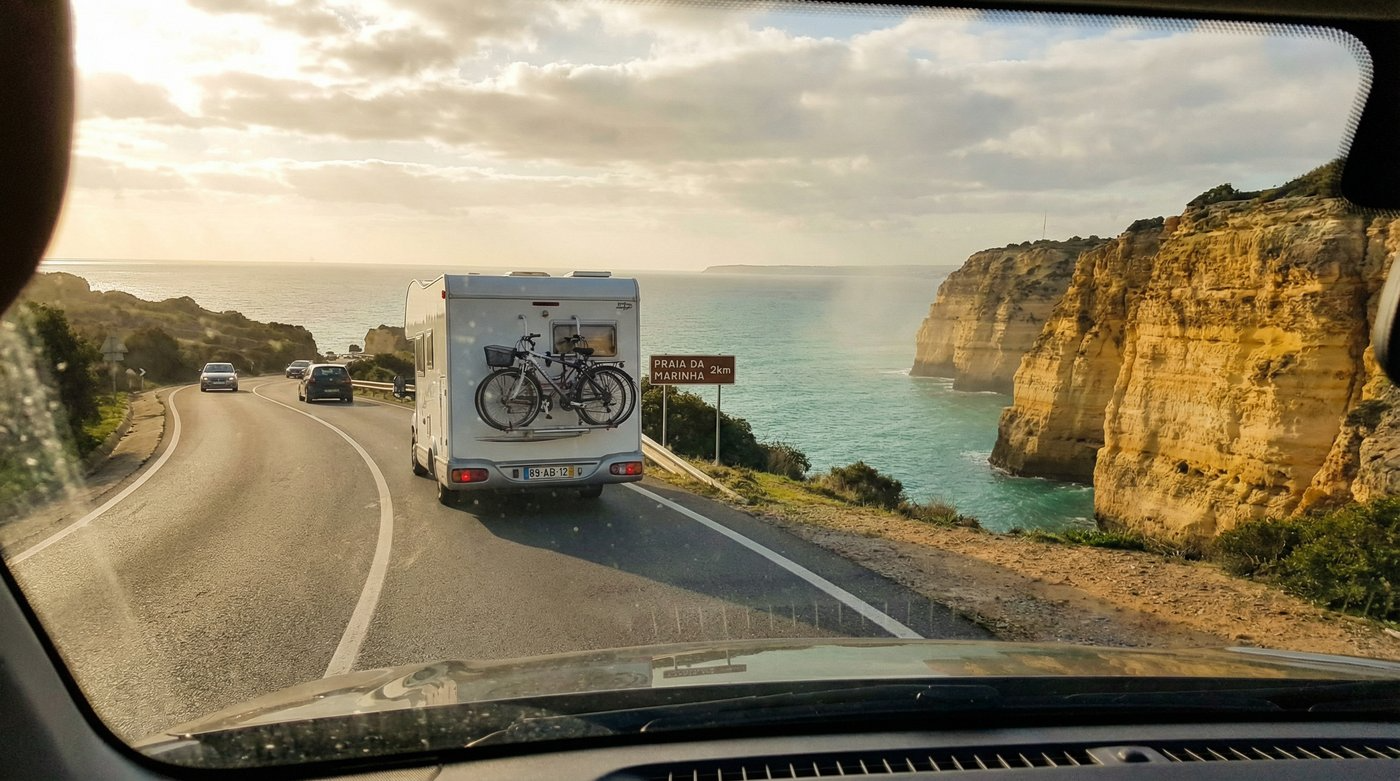
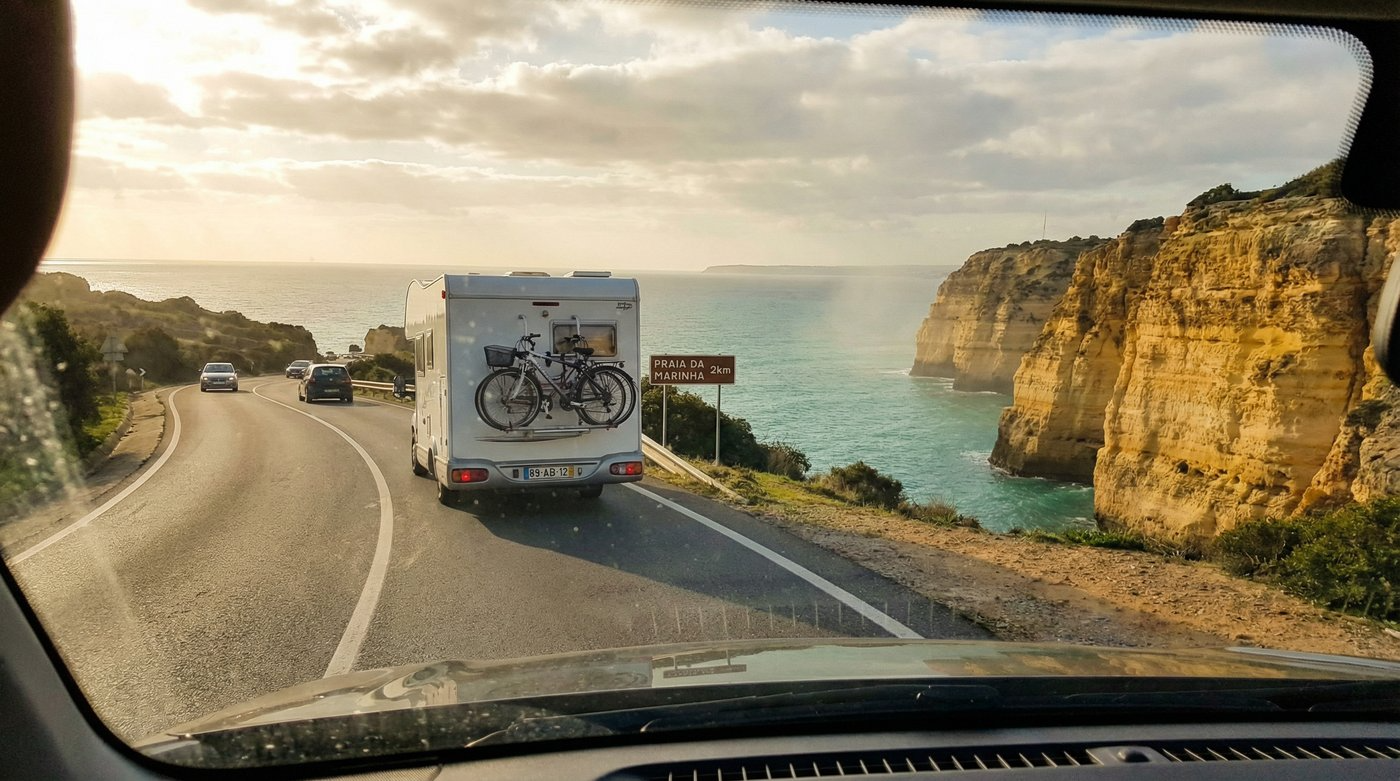
Portugal is a motorhomer’s paradise. The coastline is breathtaking, the cities are steeped in history, and the seafood is so fresh it practically swims onto your plate. But before you can find the perfect cliff-top spot to watch the sunset over the Atlantic, you need to get to grips with their toll road system. It’s a bit of a head-scratcher at first, as many of the newer motorways (identifiable by the letters ‘A’ followed by a number) are electronic-only.
Forget looking for toll booths; instead, overhead gantries will scan your number plate as you drive under them. To pay, you have a few options. The easiest for visitors is the ‘Easy Toll’ system. You’ll find designated lanes at border crossings where you can insert your bank card, which then links it to your vehicle’s registration for 30 days. It’s simple and effective. Alternatively, you can get a Via Verde visitor device, which works like a tag in other countries. Don’t be tempted to just wing it on the electronic roads, as the fines are no joke and they will find you.
Portuguese Speed Limits and Rules of the Road
Speed limits in Portugal are pretty standard. For motorhomes under 3.5 tonnes, it’s 120km/h (75mph) on motorways, 90-100km/h (56-62mph) on other main roads, and 50km/h (31mph) in towns. If you’re in a heavier vehicle over 3.5 tonnes, those limits drop to a more sedate 80km/h (50mph) on both motorways and main roads. The police are hot on speeding, but they also have a reputation for being very helpful to tourists who are clearly trying to follow the rules.
In terms of kit, you must have a reflective jacket for each person, and it must be accessible from within the cabin. A warning triangle is recommended, though not compulsory for foreign vehicles if it’s not a requirement in your home country (which it isn’t in the UK). You’ll also need your headlamp converters. One big change in recent years concerns wild camping. It used to be a free-for-all, but since 2021, the rules have tightened. You can now only stay overnight for a maximum of 48 hours in any one municipality, and it must be in a designated motorhome parking area (an ‘ASAs’). It is strictly forbidden in protected areas like nature reserves and along the coast. The drink-drive limit is 0.5g/l, so save that glass of Vinho Verde for when you’re parked up for the night.
The Netherlands: Bicycles, Canals, and (Almost) No Tolls
From the sunny south, we’re heading north to the wonderfully organised and incredibly flat Netherlands. The first piece of brilliant news for motorhomers is that their motorways are completely toll-free! You can explore the entire country without spending a single euro on road tolls, with the exception of two tunnels: the Westerscheldetunnel in the south-west and the Kiltunnel near Dordrecht. This makes a Dutch road trip surprisingly budget-friendly.
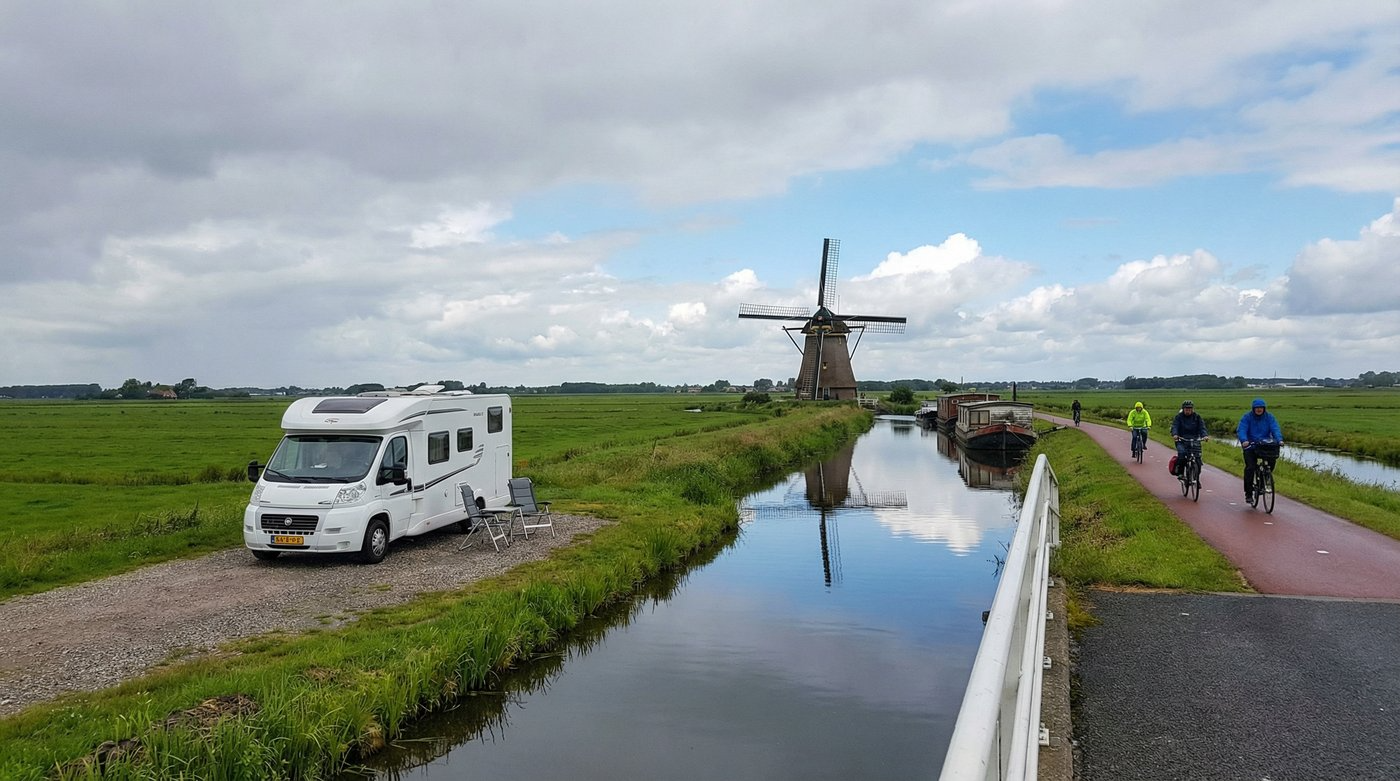
The money you save on tolls should be immediately invested in your concentration fund, because you’re going to need it to watch out for cyclists. Bikes are not just a mode of transport in the Netherlands; they are a way of life, and they have absolute priority. Always, always, always double-check for cyclists before making any turn. They are fast, silent, and they will appear out of nowhere. Expect them, look for them, and give them plenty of space.
Dutch Low Emission Zones and Overnight Stays
Like many other European countries, the Netherlands has Low Emission Zones (Milieuzones) in its major cities, including Amsterdam, Rotterdam, and Utrecht. The crucial thing to know is that these zones only apply to diesel vehicles. If you have a petrol motorhome, you can drive in without a worry. For diesel owners, you’ll need to check your vehicle’s Euro standard. Most zones require Euro 4 or higher. There’s no sticker to buy; enforcement is done by cameras scanning your number plate. Check the rules for your specific vehicle online before you travel to avoid a fine.
When it comes to overnight stays, the Dutch are quite strict. Wild camping is a definite no-no. You are not allowed to simply pull over and sleep in a car park or by the side of the road. However, the Netherlands has a fantastic network of dedicated motorhome parking spots called ‘camperplaatsen’. These range from simple, free overnight spots to more elaborate paid areas with services. They are the only legal places to stay overnight outside of a registered campsite. The speed limits are 100km/h (62mph) on motorways during the day (6am-7pm), rising to 120 or 130km/h at night in some places. For motorhomes over 3.5t, it’s a strict 80km/h (50mph) on motorways at all times.
Austria: Mountains, Music, and Mandatory Tolls
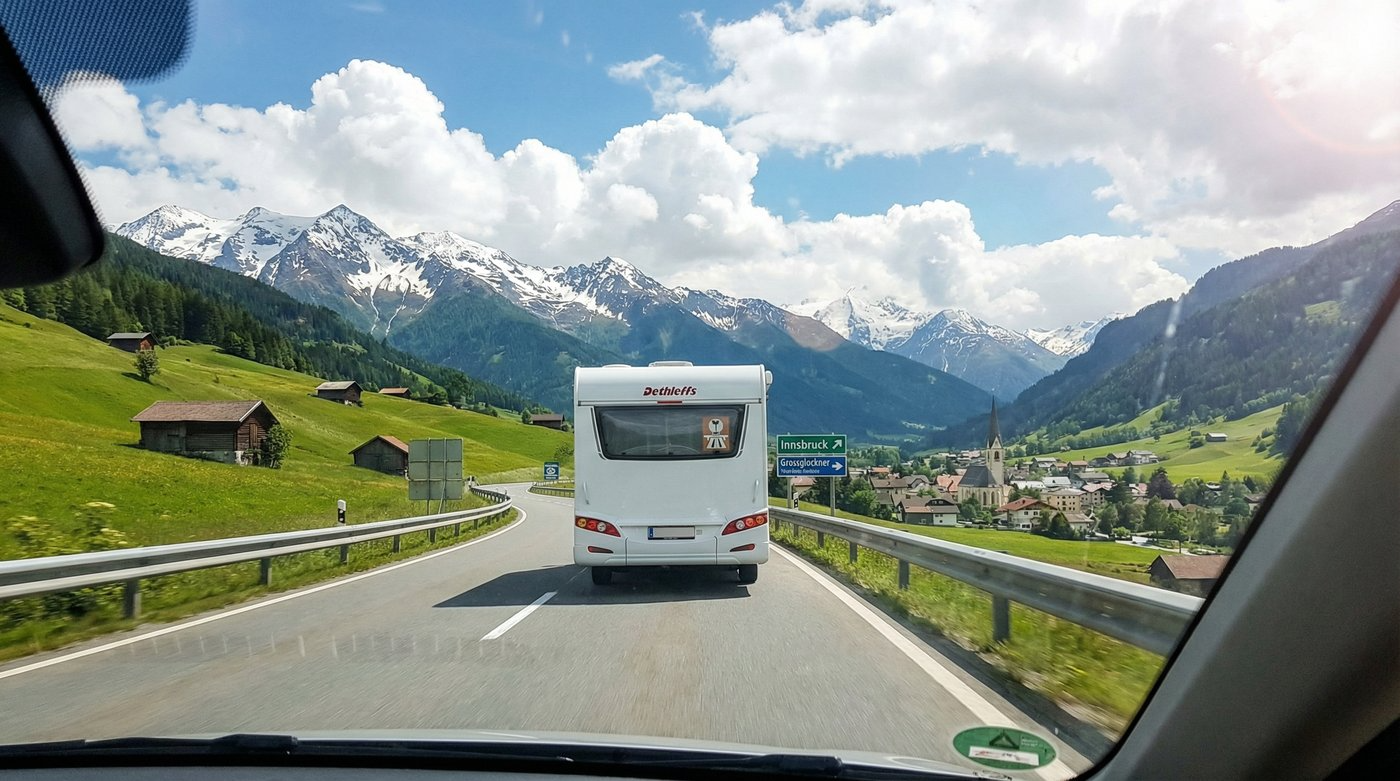
Our final destination in this part of the series is the stunning alpine wonderland of Austria. The scenery is truly epic, but the rules are taken very seriously, and the fines can be eye-watering. This is not a country where you want to plead ignorance. The most important thing to know is that to drive on any motorway or expressway in Austria, you MUST pay a toll. How you pay depends on the weight of your motorhome.
For vehicles up to and including 3.5 tonnes, you need a vignette. This can be a physical sticker that you attach to the inside of your windscreen or a digital e-vignette that you link to your number plate online. A 10-day vignette is very affordable at around €12. Get caught without one, and you’re looking at an on-the-spot fine of €120. For motorhomes over 3.5 tonnes, you need to use the GO-Box system. This is a small electronic device that you get from a GO-Box service station at the border. It tracks your mileage on toll roads and charges you accordingly. It’s a bit more of a faff, but it’s absolutely essential.
Austrian Driving: No Dash Cams, Yes Snow Chains!
On top of the general motorway toll, some of the major alpine tunnels and passes, like the Brenner Pass and the Arlberg Tunnel, have an additional ‘section toll’. Speed limits are 130km/h (81mph) on motorways for lighter motorhomes, dropping to 80km/h (50mph) for vehicles over 3.5t. The fines for speeding are severe, so stick to the limits religiously. One very important and unusual rule in Austria is that dash cams are completely illegal due to privacy laws. You must unplug it and put it away before you cross the border.
In terms of kit, you need a reflective jacket, a warning triangle, and a first-aid kit, and they must all be in the passenger compartment, not in an external locker. If you’re travelling in winter (which in Austria can mean from October to April), you must have winter tyres fitted if there are wintry conditions. Snow chains are also mandatory on certain mountain roads when the signs dictate. Wild camping is generally not permitted and is strictly enforced in the popular tourist areas of Tyrol and Salzburg. Your best bet is to use the excellent network of campsites and official Stellplatz. The drink-drive limit is 0.5g/l, but a near-zero 0.1g/l for new drivers.
The At a Glance Table
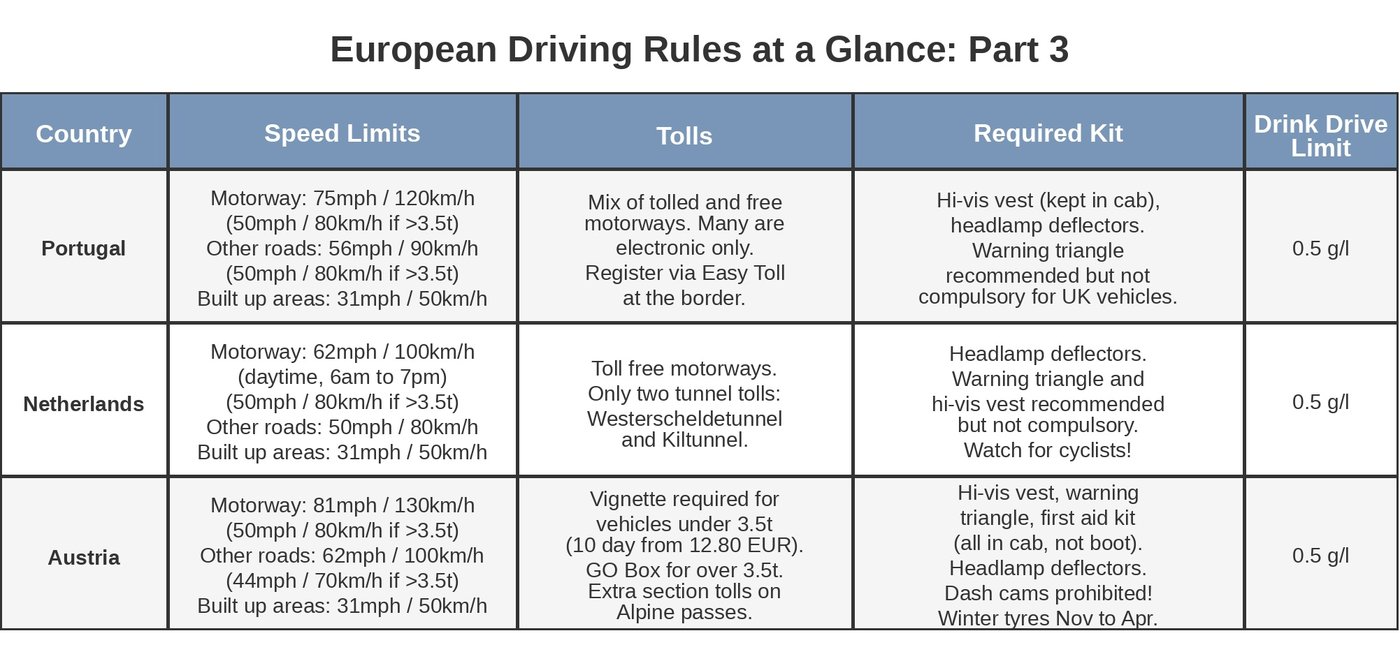
To help you keep track, here’s a handy table with the key rules for our eclectic trio. Stick it on your motorhome’s fridge!
What’s Next on Our European Adventure?
And that’s a wrap for Part 3! You’re now armed with the knowledge to confidently tackle the roads of Portugal, the Netherlands, and Austria. From electronic tolls to cyclist-filled cities and high-altitude vignettes, you’re ready for anything.
Be sure to join me for Part 4, where we’ll be setting our sights on the stunning Adriatic coastline of Croatia, the dramatic fjords of Norway, and the cool, stylish forests of Sweden. Until then, happy travels!
Subscribe to our newsletter and get the latest articles delivered straight to your inbox.

The Electric Dream Hits the Road
Welcome back, fellow road-trippers! Siobhan here with the fourth instalment of our mammoth...

For many of us, reaching 70 is a milestone that brings more freedom, not less. It’s a time for...